
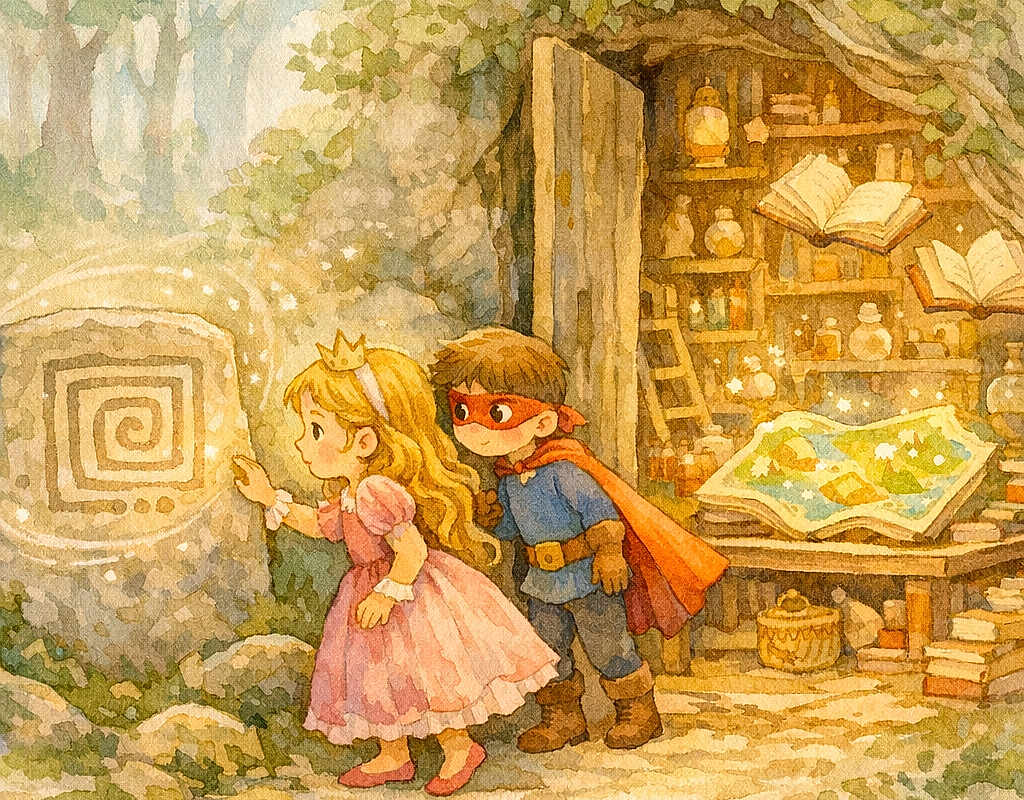
Hines had a problem most superheroes never mentioned in their dramatic speeches: he worried he might be too careful.
He had the cape, the symbol stitched in silver thread, and the ability to move so fast the world sometimes blurred at the edges. He also had a habit of pausing before every big decision, as if bravery needed to be double-checked like homework.
That morning in the Enchanted Forest, the trees leaned in as though they were listening. Their leaves were not simply green; they carried faint hints of other colors—diluted blues and shy purples—like paint that had been washed too many times. Sunlight fell in gentle columns, and somewhere a stream played a tune that sounded almost like humming.
Hines stood at the forest path’s beginning, fingers tapping against his utility belt. It was a simple belt, no lasers or grappling hooks, just practical things: a small notebook, a spool of twine, a compass that pointed toward “interesting,” and a snack bar wrapped in crinkly foil.
“Okay,” he told himself, “today I’m not overthinking.”
He took three steps, then stopped.
A soft clink drifted from deeper in the woods—metal against stone—followed by a whisper of laughter. Hines tilted his head. The Enchanted Forest didn’t laugh often, unless you counted the way some mushrooms puffed spores like tiny giggles.
“Hines!” a voice called.
He turned, and there she was: Princess Maribel of the Alder-Crown—though everyone in the forest simply called her Princess, as if the title was also her name. She wore a travel cloak the color of dark honey, practical boots, and a small crown that looked more like a polished twig circlet than a piece of heavy gold.
Princess had a reputation. In the kingdom, people said she was fearless. In the forest, the squirrels said she was stubborn. Hines thought she was both, but also surprisingly observant, the kind of person who noticed when someone’s smile didn’t reach their eyes.
She hurried up the path, cheeks flushed. “Good. You’re here. I hoped you’d still be in the forest today.”
“I’m… always in the forest,” Hines said, then winced. It came out more serious than he meant.
Princess didn’t tease him. Instead she held out her palm. Resting there was a tiny scrap of parchment with a symbol drawn in charcoal: a spiral inside a square.
“This appeared on my windowsill,” she said. “And before you say it’s probably just a prank—no one can get to my windowsill without passing the moat and the guard towers. Unless they’re a very athletic raccoon.”
Hines studied the symbol. “It looks like… a maze inside a box.”
“I think it’s a message,” Princess said. Her eyes shone with that special kind of curiosity that made trouble feel like an invitation. “My grandmother used to tell me old stories about the Enchanted Forest. About a hidden library that only shows itself when it wants to be found.”
“A library,” Hines repeated. “That sounds… peaceful.”
Princess smiled. “It does. But there’s a catch. According to the stories, the library keeps a collection of ‘lost things’ people thought were gone forever. Not just books. Objects, maps, inventions. Even crowns. Even—”
“Snack recipes?” Hines offered.
Princess’s smile widened. “Exactly. And I think the message is an invitation. Or a challenge. Or both.”
Hines felt his stomach flip in a way that had nothing to do with snack bars. “If it’s hidden, maybe it’s hidden for a reason.”
“That’s what you always say,” Princess replied, not unkindly. “And you’re not wrong. But you also always show up when someone needs help.”
Hines opened his notebook. He drew the spiral-square symbol carefully, then added a note: Possible clue. Potential trap? Unknown.
“What do you need from me?” he asked.
Princess breathed out, the way someone does when they’ve been holding a plan inside their chest too long. “I want you to come with me to find it. I don’t want to do it alone. And—” She hesitated, then lowered her voice. “My grandmother’s favorite ring is missing. It vanished last night from its velvet box. No guards saw anything. If there is a place that collects lost things… maybe it collected that, too.”
Hines’s carefulness suddenly felt useful rather than annoying. “Then we should follow the message,” he said. “But with a plan.”
Princess raised an eyebrow. “I knew you’d say that.”
They walked together beneath branches woven like cathedral arches. Hines listened to the forest. The Enchanted Forest had a rhythm: bird calls that came in pairs, wind gusts that arrived like punctuation, and a silence that sometimes lasted just long enough to make you pay attention.
After a while, the path split into three. One trail was lined with stones that glowed faintly as if remembering daylight. Another disappeared into ferns so thick it looked like the earth had grown hair. The third led toward a shallow ravine where fog clung low like spilled milk.
Princess held up the parchment scrap. “Which way?”
Hines tapped his compass. The needle didn’t point north. It spun, then trembled, then settled toward the fern-choked trail.
“Well,” he said, “my compass thinks the interesting direction is… that way.”
Princess nodded. “Then that’s our way.”
They pushed into the ferns. Each frond brushed their sleeves like the forest was checking their pockets. Hines kept an eye out for anything unusual—fresh footprints, snapped twigs, a suspiciously organized pile of acorns.
Soon, the air cooled. The light shifted. And the ferns opened into a small clearing where a single stone slab lay half-buried in moss.
On the slab was the same symbol: spiral inside a square.
Princess knelt. “It’s not charcoal. It’s carved.”
Hines crouched beside her, running his fingers along the grooves. The carving was deep and precise. “This is old,” he murmured. “Not like ‘last week’ old. Like… ‘the forest was younger’ old.”
Princess looked around the clearing. “So what now? Do we say a password? Spill tea? Offer a poem?”
Hines snorted. “If I have to offer a poem, we’re doomed.”
He examined the stone slab carefully. At its edge, barely visible under moss, was a narrow slot.
“A keyhole,” he said.
Princess frowned. “I don’t have a key.”
Hines glanced at her crown—simple, twig-like, but set with a small square jewel at its center. Not flashy, just… there.
“You said your grandmother’s ring is missing,” he said slowly. “What about this jewel? Is it new?”
Princess touched it. “No. It’s always been part of the crown. Why?”
Hines pointed at the keyhole slot. “It’s the same shape as that jewel.”
Princess’s eyes widened. “You’re not suggesting I pry a jewel out of my crown.”
“I’m suggesting,” Hines replied, “that your crown might be a key.”
Princess lifted her chin. “Fine. But if this ruins my hair, I’m blaming you.”
With careful fingers she popped the jewel free. It came out surprisingly easily, as if it had been waiting.
She slid it into the slot.
The forest held its breath.
A low click sounded, followed by a gentle vibration beneath their feet. Moss uncurled. The stone slab shifted aside, revealing stairs descending into darkness.
Princess leaned over the opening. Cool air rose, carrying the scent of paper and dust and something else—like old ink mixed with rain.
Hines’s instincts said: unknown underground place, no visible exits, do not enter.
But Princess’s missing ring—something precious, something that mattered—pulled at him.
“I’ll go first,” he said.
Princess laughed softly. “Of course you will, Superhero.”
They descended. The stairs were narrow but solid. Their footsteps echoed, and the echoes sounded… odd. Not exactly delayed, more like they were being repeated by someone trying to learn the rhythm.
At the bottom, the passage opened into a vast chamber.
It was a library.
Not the kind with neat rows and strict librarians. This one looked grown rather than built. Shelves rose from the ground like tree roots that had decided to hold books. Lanterns floated at different heights, their light warm and steady, as if held by invisible hands.
And everywhere, resting between stacks of scrolls and maps and thick volumes, were objects.
A cracked teacup. A child’s wooden boat. A silver comb. A compass with a broken glass face. A single glove embroidered with a star.
Princess walked slowly, as if afraid to breathe too hard. “It’s real.”
Hines’s chest tightened. “It’s… a collection.”
A voice spoke from somewhere between shelves.
“Not a collection,” it said, calm and clear. “A sanctuary.”
Hines spun, placing himself slightly in front of Princess. “Who’s there?”
A figure stepped into the lantern light.
It was not a monster. Not a villain. Just a person—tall, wrapped in a coat the color of faded parchment, hair streaked with silver. Their eyes were sharp but not cruel.
“I am the Keeper,” the figure said. “I keep what is lost until it can be found again.”
Princess found her voice first. “Then you have my grandmother’s ring.”
The Keeper regarded her. “Perhaps. Many rings come here. Some are dropped. Some are stolen. Some are… misplaced by grief.”
Hines narrowed his eyes. “So things can arrive here even if someone took them?”
The Keeper’s gaze flicked toward him. “If something is truly lost from its rightful place, it may drift here. But nothing is given back without understanding why it was lost.”
Princess’s impatience flared. “We understand. It was stolen. We want it back.”
The Keeper lifted a hand. The lanterns brightened slightly, as if listening. “This is not a market. You cannot simply demand what you desire. The library is old. It responds to questions, not shouting.”
Hines whispered to Princess, “Try… asking.”
Princess exhaled slowly. Then, in a steadier voice, she said, “Keeper, please. My grandmother’s ring matters to me. It belonged to her mother before her. It’s part of our family. I want to keep it safe.”
The Keeper’s face softened by a fraction. “Then you must prove you can keep safe what you seek. Not with strength. With attention.”
Hines blinked. “Attention?”
“Lost things,” the Keeper said, “are often lost because someone looked past them. Because someone hurried. Because someone assumed they would always be there.”
Princess swallowed. “What do we do?”
The Keeper stepped aside, gesturing toward a corridor formed by shelves. “Follow the Spiral Path. Answer what the library asks. Find what you are meant to find.”
Hines’s carefulness buzzed like a warning. “And if we fail?”
The Keeper’s voice remained calm. “Then you return to the surface with what you carried in—nothing more. The library does not punish. It merely waits.”
Princess glanced at Hines. “We can do this.”
Hines nodded, though his mind was already building plans: stay together, mark turns, don’t touch random cursed-looking objects.
They entered the corridor. Immediately, the shelves shifted behind them with a soft shushing sound, sealing their way back. Not violently. Just… decisively.
Princess muttered, “Well. That’s cozy.”
Hines tried to keep his voice light. “Cozy like being inside a book you can’t put down.”
The corridor curved, spiraling inward. As they walked, objects on shelves seemed to follow them with invisible eyes: a pair of spectacles, a toy soldier, a tiny music box.
Soon they reached the first challenge.
A pedestal stood in the center of a round room. On it lay three items: a ring of plain copper, a ring of bright silver, and a ring of polished wood.
A whisper filled the room, not from one mouth but from the air itself: “Which is the ring that belongs to a queen who never ruled?”
Princess frowned. “That sounds like a riddle.”
Hines examined the rings. None looked like a royal treasure. He thought about the phrase: queen who never ruled. Could mean someone titled but not in power. Or someone who chose not to rule.
Princess murmured, “A queen who never ruled… could be a queen in a game.”
Hines snapped his fingers. “Chess.”
Princess’s eyes widened. “A chess queen!”
They looked again. The wooden ring had faint carved squares along its band, like a tiny checkerboard.
Princess lifted it carefully. The moment her fingers touched it, the whispering stopped. A soft chime rang, and a hidden drawer slid open in the pedestal, revealing a small token: a thin tile etched with the spiral-square symbol.
Hines picked up the tile. It was warm. “One step,” he said.
They continued along the spiral corridor to the second room.
This chamber was lined with mirrors of different sizes. Some were cloudy. Some reflected too sharply. In the center, a stone table held a single object: a key.
The air whispered again: “Take the key that opens what you fear to open.”
Princess stared at the key. “Is there… more than one?”
Hines looked around. The mirrors reflected them from many angles. In one mirror, Hines’s cape looked too long. In another, Princess’s crown seemed heavier.
Then he realized: the mirrors weren’t just reflecting. They were offering choices.
In a tall mirror, he saw himself holding the key and opening a door. Behind the door was a blinding light. In another mirror, he saw himself turning away, leaving the key untouched, walking back to the surface.
Hines swallowed. His fear wasn’t of the dark or monsters. It was of making a wrong choice and causing damage he couldn’t fix.
Princess watched him. “You’re thinking too hard again.”
“I know,” Hines admitted. “But this question is… personal.”
Princess stepped closer, voice quiet. “What do you fear to open?”
Hines took a breath. “The possibility that I’m not brave. That I’m just careful. That when it’s time to act, I’ll freeze.”
Princess nodded, surprisingly serious. “Then maybe the key isn’t for a door in the library. Maybe it’s for that.”
Hines looked at the key on the table. It was plain iron, but the bow of it was shaped like—he leaned closer—a small shield.
He reached out and took it.
The mirrors shimmered. For a moment, Hines saw not a superhero, but a kid who sometimes wanted to hide behind planning. Then the vision snapped back, and a second drawer opened in the stone table, offering another spiral-square tile.
Princess grinned. “Two.”
They followed the corridor again. The spiral tightened. The air smelled more strongly of rain-ink, and the lanterns floated closer as if trying to hear their footsteps.
In the third room, they found something that made Princess gasp.
A velvet box sat on a shelf at eye level. It was the exact shade of midnight blue as the box in Princess’s grandmother’s room.
Princess rushed to it, then stopped herself, hands hovering. “That’s it. That’s the box.”
Hines held up a hand. “Wait. The library likes questions.”
The whisper came, right on cue: “Open what is yours only if you can name what it cost.”
Princess’s brow furrowed. “What it cost?”
Hines’s mind raced. A family heirloom cost time, care, history. It might have cost sacrifices—someone giving it up, someone protecting it.
Princess spoke slowly, as if choosing each word like a stepping stone. “It cost trust. My grandmother trusted me with it. And it cost her memories. Every time she looked at it, she remembered people she loved who are gone.”
Silence.
Then, gently: “Accepted.”
The box clicked open by itself.
Inside was a ring.
Princess’s breath caught. The ring was gold with a pale green stone—soft as leaf-light. Tiny markings ran around it like a secret alphabet.
Princess lifted it. Her eyes were bright, but she didn’t cry. She simply held it like something alive.
“We did it,” she whispered.
Hines smiled, relief spreading through him.
Then the whisper returned, different now, almost playful: “Not yet.”
The shelves shifted. The room’s walls slid, and the velvet box shelf sank into the floor like an elevator.
Princess clutched the ring. “What do you mean, not yet?”
Hines looked around. “We still need a way out. And… the Keeper said find what you are meant to find.”
A new pedestal rose from the ground. On it sat a thick book with no title.
Princess eyed it suspiciously. “That looks like homework.”
Hines stepped closer. The cover was leather, worn at the corners. When he opened it, the pages were not filled with words.
They were filled with maps.
Not ordinary maps. These showed the Enchanted Forest in layers: the paths people walked, and the hidden paths animals used, and the paths wind took between branches. Symbols marked places Hines had never seen: a pond shaped like a crescent moon, a hill with a hollow heart, a grove where the shadows pointed the wrong way.
At the center of the map, a spiral-square symbol pulsed faintly.
The whisper said: “A library cannot walk. A forest does. Take the Atlas of Returning, and you may return.”
Princess leaned in. “Is that… a treasure?”
Hines ran his finger along the map’s edge. “It’s more than treasure. It’s a guide to everything the forest hides.”
Princess’s grin came back, fierce and delighted. “Take it. Take it now.”
Hines hesitated—then remembered the key shaped like a shield in his pocket and his promise not to overthink.
He closed the book and tucked it under his arm.
The moment he did, the lanterns rose higher, lighting a new passage. The shelves opened like a doorway, revealing stairs going up.
Princess exhaled. “Finally.”
They climbed. The air warmed. The scent of leaves returned. They emerged not in the clearing where they’d entered, but in a different part of the Enchanted Forest—near a stream that sang more clearly now, as if pleased.
The stone slab was nowhere to be seen. Only ordinary moss and ferns remained.
Princess slipped the jewel back into her crown and, for safety, placed the ring in a small pouch at her belt. “I’m not putting it on yet,” she said. “Not until I’m in my grandmother’s room with the door locked and a guard outside who is not an athletic raccoon.”
Hines laughed, then sobered. He looked at the Atlas of Returning. Its cover felt warm in the sunlight, like it still remembered the library’s lantern glow.
Princess nudged him. “You’re thinking.”
“I’m wondering,” Hines admitted, “why the library gave us this.”
Princess shrugged. “Maybe because you asked the right questions. Maybe because it trusts you.”
Hines glanced at her. “You think a hidden library can trust people?”
Princess lifted her chin toward the trees. “The forest does. Sometimes it throws thorns at us, but it also gives berries. It’s complicated. Like people.”
They followed the stream for a while, the Atlas tucked safely. As they walked, Hines opened the book again and saw something new: the map shifted slightly, updating, as if it knew where they were.
Princess gasped. “It’s moving.”
“It’s responding,” Hines said, wonder sliding into his voice. “Like it’s alive.”
They tested it. Princess stepped off the path toward a cluster of trees, and the Atlas showed a dotted line appearing, as if recommending a route.
Princess returned to the path. The dotted line vanished.
“It’s like the forest is writing directions,” she said.
Hines’s carefulness, usually a heavy backpack, suddenly turned into a tool. “We could use this to find lost things,” he said. “Not just rings. People lose pets. People lose letters. People lose… courage.”
Princess gave him a sideways look. “You mean you.”
Hines opened his mouth to protest, then closed it. He wasn’t offended. He was relieved she could say it plainly.
They reached a part of the forest where the trees grew closer together, and the light dimmed. The stream’s song became quieter, as if nervous.
Princess slowed. “Do you feel that?”
Hines nodded. “The forest is… tense.”
The Atlas page fluttered. A symbol appeared: a small circle with jagged lines, like a buzzing star.
“What is that?” Princess asked.
Hines traced it. A note appeared on the page in tiny script—letters forming as if written by an invisible pen.
UNSORTED LOSS.
Princess frowned. “Unsorted?”
Before Hines could answer, a sound rose from ahead: a low, upset humming—like a swarm of bees, but slower, heavier.
They stepped into a clearing and found the source.
A young stag stood trembling near a fallen log. Around its antlers, a mess of thin metal wire was tangled, biting into the velvet skin. The stag’s eyes were wide with fear, and it pawed the ground, unable to free itself.
Princess’s face softened immediately. “Oh no.”
Hines raised his hands, moving slowly. “Easy,” he murmured to the stag. “We’re not here to hurt you.”
The stag snorted, trying to back away, but the wire caught on a branch and pulled.
Princess took a step forward.
Hines caught her sleeve. “Wait. If it panics, it’ll get tighter.”
Princess clenched her jaw but nodded.
Hines pulled out his twine and notebook. He tore a page from the notebook and crumpled it softly, then tossed it gently to the side, away from them.
The paper landed with a whisper. The stag’s ears flicked toward it.
Hines spoke softly to Princess. “We need it to focus somewhere else. Not on us.”
Princess understood. She reached into her pocket, pulled out a small ribbon—gold, probably from some official ceremony—and tied it to a low branch, letting it flutter.
The stag stared at the ribbon.
Hines moved. Fast, but controlled. He stepped close, looping twine around part of the wire to hold it steady, then used a small tool from his belt—a simple cutter—to snip the wire in two places.
The stag jerked, but the wire loosened instead of tightening.
Princess whispered, “Good. Good.”
Hines eased the wire away, careful not to scrape the antlers. When the last piece fell to the ground, the stag froze, then sprang backward, free.
It stood at the edge of the clearing, breathing hard.
Princess spoke gently. “You’re safe.”
The stag looked at them for a long moment. Then it dipped its head once—almost like a bow—and bounded away into the trees.
Hines exhaled. “Unsorted loss,” he said. “That wire wasn’t supposed to be here.”
Princess stared at the cut wire on the ground. “Someone dropped it?”
Hines shook his head. “Or someone left it. But the library collects lost things. This… feels like something that fell between places. Not lost to be found, just lost to cause trouble.”
Princess looked at him sharply. “You said there was no villain.”
“I didn’t say that,” Hines replied. “I said I don’t sense one. But not every problem has a person behind it. Sometimes it’s just… carelessness that keeps rolling.”
Princess bent and picked up the wire, coiling it so no other animal would get caught. “Then we’ll be the ones who stop it.”
The Atlas page fluttered again. The UNSORTED LOSS symbol faded, replaced by a new message:
RETURNED TO ORDER.
Princess blinked. “The book is… thanking us?”
Hines smiled. “Maybe it’s keeping track.”
They continued, and the forest seemed to relax. The stream’s song grew louder again, and the light returned in brighter patches.
By late afternoon they reached the edge of the forest where the kingdom’s stone road began. Princess could already see the distant outline of her family’s towers.
She stopped and turned to Hines. “Come with me. To the castle. My grandmother will want to thank you.”
Hines hesitated. Castles made him nervous. Too many hallways, too many expectations. But he also knew that returning the ring wasn’t just about completing a quest; it was about closing a worry in someone else’s heart.
“I’ll come,” he said.
Princess smiled as if she’d expected that answer all along.
At the castle, Princess led Hines through quiet corridors to a room that smelled of tea and old cedar. Her grandmother sat by the window, shawl wrapped around her shoulders, eyes sharp despite her age.
Princess knelt beside her and opened the pouch. “Grandmother,” she said softly, “we found it.”
The old woman’s hands trembled as she took the ring. She held it up to the light, and for a moment her expression changed—not into sadness, but into something like relief that had been waiting a long time.
“I knew the forest would not swallow it forever,” she murmured.
Hines shifted awkwardly, suddenly unsure where to put his hands.
The grandmother looked at him. “You are Hines,” she said, not a question.
Hines blinked. “Yes, ma’am.”
“You have the look of someone who listens before leaping,” she said. “That is rarer than people think.”
Princess crossed her arms, amused. “He listens so much he sometimes forgets to leap.”
The grandmother chuckled. “Then it is good he met a Princess who does not.”
Princess leaned her head against her grandmother’s shoulder. “We also found something else,” she said, nodding to the Atlas tucked under Hines’s arm.
The grandmother’s gaze sharpened. “The Atlas of Returning.”
Hines held it out carefully. “The library gave it to us.”
The grandmother didn’t take it. Instead she studied Hines as if reading a page. “The library does not give gifts lightly,” she said. “It gives tools to those who will use them.”
Princess’s eyes gleamed. “That means we can go back.”
“Not to take,” the grandmother warned gently. “To return. To notice. To mend what becomes tangled.”
Hines felt the key in his pocket, the shield shape pressing against his thigh like a reminder. “I think I understand,” he said. “Not perfectly. But… enough to try.”
The grandmother nodded once. Then she reached into a small drawer beside her chair and withdrew a box.
Not velvet. Wood, polished smooth.
She opened it and revealed two items.
The first was a small medal on a leather cord: a simple silver shield engraved with a spiral inside a square.
The second was a pouch heavy with coins that glittered like sunlight caught in metal.
Princess’s jaw dropped. “Grandmother!”
The grandmother’s eyes twinkled. “Do not look at me like that. Heroes who help my family do not leave with only polite words. The medal is older than this castle. It is a marker—proof to the forest that you are a friend of returning things to where they belong.”
She pushed the pouch toward Hines. “And this,” she added, “is for practical needs. Capes tear. Boots wear out. And even superheroes must eat.”
Hines’s cheeks warmed. “I can’t—”
Princess interrupted, firm. “Yes, you can. You earned it. Also, I have seen your snack bars. You need better food.”
Hines let out a reluctant laugh, then accepted the medal and the pouch. The medal felt surprisingly heavy for its size, as if it carried the weight of many stories.
He slipped it around his neck.
The grandmother smiled. “Now you carry a sign that opens doors. Not locked doors. The kind that require trust.”
Princess bounced on her heels, unable to hide her excitement. “So when do we use the Atlas?”
Hines looked out the window at the distant dark line of the Enchanted Forest. He thought of the wire tangled in the stag’s antlers, of lost objects waiting in the library’s warm lantern light, of questions that demanded attention instead of force.
“Soon,” he said. And to his own surprise, he meant it.
Princess leaned closer, voice conspiratorial. “Next time, we find something legendary. Something huge.”
Hines raised an eyebrow. “Like what?”
Princess grinned. “A treasure chest. Or a crown. Or a recipe for the best cake in the world.”
Hines tapped the Atlas’s cover. “If it exists, this might lead us to it.”
The grandmother sipped her tea, watching them with quiet satisfaction. “Just remember,” she said, “the forest does not only hide prizes. It hides responsibilities.”
Hines nodded. “I’m good at responsibilities.”
Princess laughed. “He is. Sometimes he hugs them like a shield.”
Hines touched the medal at his chest, feeling the spiral-square symbol beneath his thumb. He had come to the forest thinking he needed to be bolder.
He left with something better than a lecture.
He left with a map that moved, a medal that marked him as trustworthy, a pouch of coins that clinked with real reward, and a new understanding that carefulness could be a kind of courage—if you used it to act, not to hide.
That night, as Hines and Princess walked back toward the forest’s edge to part ways, the trees seemed to lean in again, listening.
Princess waved her hand. “Goodnight, Enchanted Forest! Try not to lose anything important while we’re sleeping.”
A gust of wind rustled the leaves, and for a second it sounded almost like laughter.
Hines adjusted his cape and nodded toward the shadowed paths. “We’ll be back,” he said.
And the Atlas of Returning, tucked under his arm, fluttered one page as if agreeing.