
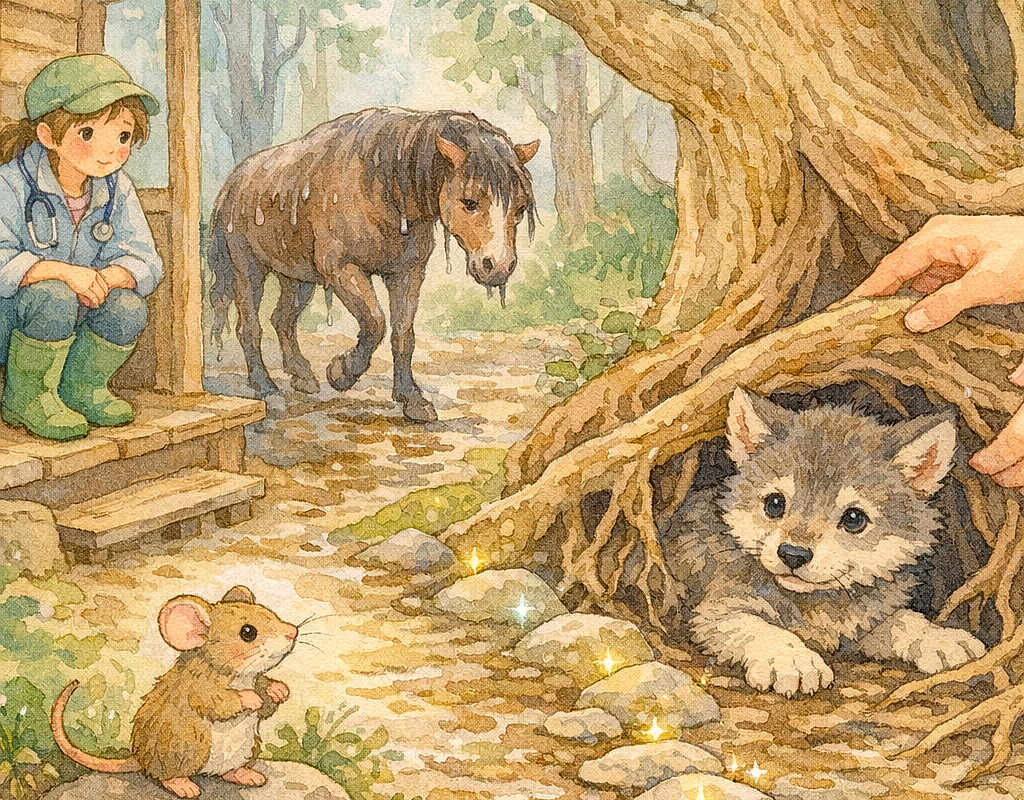
Aurelia the Vet lived in a house that never truly slept.
It was an ordinary house on the outside—pale siding, a porch swing that squeaked like a friendly cricket, and a mailbox that leaned slightly to the left as if it was always listening. But inside, every room carried small signs of Aurelia’s work: folded towels stacked like neat clouds, jars of herbs labeled in careful handwriting, a basket of clean bandages, and a stethoscope that seemed to wander from table to chair to windowsill the way curious cats did.
Aurelia was a girl in late elementary school, tall enough to reach the top shelf if she stood on her toes, and old enough to know that being brave didn’t always feel like being brave.
She wasn’t the kind of brave that burst into a room shouting, “Fear not!”
She was the kind of brave that took a slow breath, checked the facts, and stepped forward anyway.
Most afternoons after school, Aurelia tied her hair back with an elastic, washed her hands for the length of a full chorus of her favorite song, and opened her “home clinic” in the kitchen. She didn’t charge money. She accepted payment in stories, drawings, and occasionally in a very suspicious-looking acorn.
On the day our story begins, rain had been tapping on the windows since morning. It wasn’t dramatic thunder-rain. It was patient rain, the kind that could convince you the sky was practicing handwriting.
Aurelia had just finished wiping down the counter when she heard it.
A thud.
Then a scrape.
Then a sound like someone trying to cough politely while also carrying a sack of potatoes.
Aurelia froze, dish towel in hand.
Her house, as busy as it was, didn’t usually produce mystery noises. Not unless she had left her backpack too close to a chair again.
The thud came from the hallway.
Aurelia stepped out of the kitchen and saw a wet trail on the floorboards, glittering faintly under the ceiling light.
“Okay,” she whispered to herself, because whispering made problems feel smaller. “That’s… new.”
Another scrape, closer to the front door.
Aurelia walked carefully, like she was approaching a skittish animal—or a cranky vacuum cleaner.
When she opened the front door, she found a horse.
Not a tiny pony. Not a neighbor’s pet on the loose.
A full horse, chestnut-brown and dripping rain, standing on her porch as if it had an appointment.
The horse’s mane was tangled and full of leaves. One ear flicked forward in a determined way. The other ear drooped slightly, as if it was tired of holding up the day.
And—most alarming—its front left hoof was lifted off the wood, hovering.
The horse looked at Aurelia with eyes that seemed to say, I am not here for compliments.
Aurelia’s mouth opened, then closed.
She had treated cats, rabbits, dogs, and once a goose with an extremely dramatic personality.
But a horse on a porch was new.
Aurelia swallowed.
“Hi,” she said, because greetings were usually safe. “I’m Aurelia. Um. Do you need help?”
The horse huffed softly, like it was trying not to be rude.
Then, from somewhere near the horse’s shoulder, a tiny voice squeaked, “Yes, we do! And quickly!”
Aurelia blinked.
A mouse climbed out of the horse’s wet mane like a sailor climbing a rope ladder. The mouse was gray and slick with rain, with whiskers that quivered as if they had their own opinions. He wore—Aurelia had to stare twice—a small button tied around his neck with string, like a medal.
The mouse put his paws on his hips.
“I told you she’d answer,” the mouse said to the horse. “Humans with kind eyes always do.”
Aurelia stared.
Talking animals were not part of her usual routine.
Then again, neither was a horse on her porch.
She took another slow breath and let her brain catch up.
“Okay,” she said carefully. “I’m… not going to ask how you’re talking right now. I’m going to ask what’s wrong.”
The horse lowered its head a little, and Aurelia saw the problem.
A thin metal shard—like a twisted piece of nail or wire—was lodged near the edge of the hoof.
Aurelia’s stomach tightened.
“Horses can’t just… walk around with that,” she said.
The mouse nodded vigorously, almost tipping himself over.
“We know!” he squeaked. “His name is Bracken. He’s stubborn, loyal, and very bad at admitting he’s in pain.”
Bracken snorted as if to say: I am not bad at admitting anything.
Aurelia pushed the door wider.
“Come in,” she said. “Carefully. Please don’t break my coat rack.”
Bracken stepped into the hallway with the delicacy of someone trying not to crush a world made for smaller creatures. His hooves clopped softly, and the mouse hopped down to the floor and scurried to keep up.
Aurelia led them to the kitchen, because it had the easiest floor to clean and the best light.
“On the mat,” she instructed.
Bracken stood on the thick rug Aurelia used for messy projects. He shifted his weight, trying to keep pressure off the injured hoof.
Aurelia washed her hands again, then grabbed her supplies: antiseptic, tweezers, gauze, a hoof pick she kept for exactly the day she might need it (and because she liked being prepared), and a small flashlight.
The mouse climbed onto the chair and leaned forward like an anxious coach.
“Please don’t faint,” he whispered.
“I don’t faint,” Aurelia said.
“I said that last time,” the mouse admitted, “and then I did faint. So I’m working through my worries out loud.”
Aurelia crouched beside Bracken.
“Bracken,” she said softly, “I’m going to touch your hoof. If you’re scared, you can stomp—on the rug, not on me. And if you’re in pain, you can tell me.”
Bracken looked away for a moment, then lowered his head and exhaled.
It wasn’t exactly permission, but it was close.
Aurelia gently took the horse’s hoof, supporting it in both hands the way she’d learned from books and careful videos.
The shard was sharp, and it had gone in at an angle.
Aurelia’s mind clicked into focus.
Step one: calm.
Step two: clean.
Step three: remove.
She cleaned around the wound with antiseptic. Bracken’s muscles tightened, but he didn’t yank away.
“You’re doing great,” Aurelia murmured.
The mouse whispered, “Tell him he’s heroic. He likes that.”
“I can hear you,” Bracken seemed to say with an annoyed flick of his ear.
Aurelia steadied her hands. She used the tweezers to grip the metal.
“Quick and smooth,” she told herself.
She pulled.
The shard slid out with a tiny, awful squeak of metal against hoof. Aurelia immediately pressed gauze against the spot.
Bracken shuddered, then went still.
Aurelia glanced up.
“Bracken?”
The horse didn’t collapse, which was good. But his eyes had that distant, stubborn glaze of someone trying to pretend nothing had happened.
“You’re allowed to be hurt,” Aurelia said, firm but kind.
Bracken exhaled again, longer this time.
The mouse let out a breath he’d clearly been holding.
“Oh thank cheese,” he whispered.
Aurelia wrapped the hoof carefully and then added an extra layer for padding.
“You can’t run on it,” she said. “You need rest. And I want to check it again tomorrow.”
Bracken’s ears moved. Not quite agreement, but not quite refusal.
The mouse nodded as if Aurelia had just solved a complicated equation.
“There’s more,” the mouse said.
Aurelia paused. “More?”
The mouse’s whiskers drooped.
“We didn’t come only for the hoof. That’s what got us to your door, but… it’s not the main problem.”
Aurelia’s heart did a small, uneasy twist.
“Tell me,” she said.
The mouse climbed down and paced in tiny steps.
“There’s a wolf,” he said. “In the back part of the neighborhood. Near the old line of trees behind the houses. It’s been seen.”
Aurelia’s brain filled in images—sharp teeth, yellow eyes, newspaper headlines.
But she forced herself to ask the next question instead of letting fear do all the talking.
“Is it hurt?”
The mouse stopped pacing.
“Yes,” he squeaked. “And hungry. And—this is the part that makes Bracken insist on being a hero—stuck. Like it can’t leave.”
Aurelia’s eyebrows rose.
“Stuck how?”
The mouse hesitated.
“As if something in the ground is holding it,” he said. “Or something in its mind. It keeps circling the same place. It growls at anyone who gets close, but it also… doesn’t run away. Not even when dogs bark.”
Aurelia leaned back against the counter.
A wolf behind the houses.
A hurt wolf.
A wolf that couldn’t—or wouldn’t—leave.
There was no villain in this story, no obvious enemy hiding in shadows.
But there were still problems. And problems needed solving.
Aurelia looked at Bracken’s bandaged hoof.
“You can’t go anywhere,” she told him.
Bracken snorted.
The mouse translated cheerfully, “He says he can go anywhere he pleases.”
Aurelia narrowed her eyes at the horse.
“I’m the vet,” she said. “You’re the patient. I win.”
Bracken’s nostrils flared, and for a moment Aurelia wondered if he would argue.
Instead, the horse lowered his head and—very slowly—shifted his weight, testing the bandage.
Then he did something that surprised Aurelia.
He took one careful step back.
It looked like the closest thing a horse could do to, Fine.
Aurelia turned to the mouse.
“What’s your name?”
The mouse puffed up proudly.
“Thimble,” he said. “Because I once lived in a sewing basket and survived three tragic tumbles.”
Aurelia nodded as if that explained everything.
“Okay, Thimble,” she said. “If there’s a hurt wolf, we need to help it. But we also need to be smart. Wolves don’t exactly line up politely for checkups.”
Thimble’s ears drooped.
“We tried leaving food,” he admitted. “But it didn’t touch it. It just stared at it like it didn’t know what it was allowed to want.”
That sentence landed in Aurelia’s chest with a heavy, strange feeling.
Aurelia glanced at the rain sliding down the window.
“I can’t go alone,” she said. “And I can’t bring Bracken.”
Bracken’s ears pricked up, like he was offended by the truth.
Aurelia continued anyway.
“But I can bring supplies. And I can bring… you, if you’re willing to help me stay calm.”
Thimble saluted with one paw.
“I’m excellent at panic management,” he squeaked.
Aurelia raised an eyebrow.
“You fainted earlier,” she reminded him.
Thimble nodded solemnly.
“Yes,” he said. “I am excellent at identifying when panic has arrived.”
Aurelia almost laughed, and the almost-laugh loosened something in her shoulders.
She packed a small bag: bandages, antiseptic, a soft muzzle meant for dogs (it might help with a wolf, she hoped), a thick towel, and a piece of sausage from the fridge.
Then she added something else.
From the drawer where she kept odd useful items, she pulled out a small silver whistle.
It wasn’t magical. It wasn’t special.
But it was loud.
And sometimes loud was what you needed when you were afraid.
“Bracken,” she said, “you stay here. Rest. If anything happens—if you need anything—make noise. Knock over a chair. I don’t know. Horse stuff.”
Bracken’s eyes followed her, and for a moment he looked less stubborn and more worried.
Thimble climbed into Aurelia’s jacket pocket, peeking out like a tiny captain.
“Forward!” he squeaked.
Aurelia opened the back door.
The rain had eased into a mist. The yard smelled like wet soil and crushed leaves.
As they walked toward the line of trees behind the houses, Aurelia kept her steps steady and her breathing even. She remembered what her science teacher had said about fear: it made your body fast, but it didn’t always make your mind smart.
Aurelia wanted smart.
They passed fences, muddy patches, and a narrow gap where the neighborhood ended and the trees began.
The trees looked different in the rain. Not scary, exactly.
Just older.
Thimble whispered, “He’s this way.”
Aurelia followed, stepping over a fallen branch.
Then she heard it.
A low, rough breathing.
Not a growl.
More like someone trying to breathe around pain.
Aurelia stopped.
Between two thick shrubs, there was a clearing that looked like it had been used as a path once, long ago. The ground dipped slightly, and the mud was churned up with tracks.
And in the middle of it sat a wolf.
He was larger than Aurelia expected, his fur a mix of gray and brown, darkened by rain. His shoulders were powerful, but his posture was wrong—too tense, too careful.
One of his hind legs was stretched out oddly, as if he couldn’t pull it in.
His eyes lifted toward Aurelia.
They were not yellow.
They were a clear, sharp amber, like the color of late autumn sunlight.
The wolf’s lips pulled back.
A warning.
Thimble’s tiny claws gripped Aurelia’s pocket.
“Don’t run,” he whispered.
“I wasn’t going to,” Aurelia whispered back, though her legs didn’t fully believe her.
She raised her hands slowly, showing she held nothing threatening.
“Hi,” she said, because apparently greetings were still her first tool. “I’m Aurelia. I help animals.”
The wolf’s ears flicked.
He didn’t charge.
He didn’t relax either.
Aurelia took one slow step forward, then stopped.
The wolf’s gaze flicked to her bag, then to her hands.
Thimble leaned out.
“He understands more than most,” Thimble squeaked softly. “He’s just… not sure if he should.”
Aurelia lowered herself to a crouch, keeping distance.
“I’m going to toss something,” she said. “Food. Not a trap.”
She pulled the sausage from her bag and gently tossed it onto the mud a few feet from the wolf.
The sausage landed with a soft plop.
The wolf stared at it.
Then he stared at Aurelia.
Then, slowly, he leaned forward and sniffed.
He did not eat it.
Instead, he nudged it—pushing it away.
Aurelia frowned.
Thimble whispered, “He did that before.”
Aurelia’s mind searched for reasons.
Was he too hurt to focus on food?
Was he afraid it was poisoned?
Or…
Aurelia looked down at the mud.
It was thick, almost sticky. The clearing sloped into a shallow depression where rainwater collected.
And there—half-hidden—was something that didn’t belong.
A loop of old wire, rusted and bent, like the remains of a snare.
The wolf’s leg wasn’t trapped by a monster.
It was trapped by something humans had left behind.
Not on purpose, maybe.
But harm didn’t always need a plan.
Aurelia felt anger spark in her chest, hot and focused.
Then she felt something else.
Empathy.
Because if she had been caught by pain, would she eat a random offering?
Or would she stare at it, suspicious and tired, thinking about all the ways wanting could be dangerous?
Aurelia spoke gently.
“You’re stuck,” she said to the wolf. “I see it.”
The wolf’s ears tipped back.
His growl rumbled low.
Aurelia didn’t move closer.
Instead, she did the thing she was best at.
She observed.
The wire loop was around the wolf’s hind leg, tight enough to hold, not tight enough to cut deep—yet. But the mud and his struggling had twisted it.
If she rushed in, he might panic and worsen the injury.
Aurelia looked at Thimble.
“Can you talk to him?” she whispered.
Thimble swallowed.
“I can try,” he squeaked. “But he might… not be in the mood for mouse speeches.”
Aurelia nodded.
“Tell him I’m going to help. Not hurt.”
Thimble climbed down from her pocket and stepped into the open, tiny and bold against the wolf’s size.
The wolf’s head lowered.
His eyes narrowed.
Thimble raised both paws.
“Sir Wolf,” he squeaked, voice trembling but clear, “this is Aurelia the Vet. She pulled metal from Bracken’s hoof today, and Bracken is dramatic, so trust me, it was not easy. She has good hands. She wants to free your leg. She won’t trap you. Also, please don’t eat me. I’m mostly button and nerves.”
The wolf blinked.
His lips loosened slightly, not a smile—wolves didn’t do that—but a tiny lessening of threat.
Aurelia took that as a sign.
She reached into her bag and pulled out the towel.
“I’m going to cover your head,” she said, speaking calmly. “Not to scare you. It can help you stay calm. Like when people close their eyes before a shot.”
The wolf’s growl rose.
Aurelia stopped immediately.
“Okay,” she said. “No towel. We’ll do it your way.”
Thimble squeaked, “He appreciates being consulted.”
Aurelia didn’t know if that was true, but she liked the idea.
She slid her bag onto the ground and took out the antiseptic and bandages, placing them where the wolf could see.
Then she did something that made her heart beat fast.
She set her whistle beside her, within reach.
Not to threaten.
To remind herself she had a choice.
Aurelia inched closer, careful to keep her body turned slightly sideways. Predators read direct stares as challenges, she remembered.
She kept her eyes on the wire.
When she was close enough, she reached out slowly.
The wolf’s muscles tensed.
Aurelia paused.
“I’m going to touch the wire,” she said.
The wolf didn’t move.
That was permission.
Aurelia’s fingers closed around the rusted loop.
It was cold, gritty.
She tried to unwind it, but it resisted.
The wire had twisted into a tight knot.
Aurelia’s hands were strong for her age, but she wasn’t a machine.
Thimble squeaked, “Do you have pliers?”
Aurelia’s breath hitched.
“In the house,” she whispered.
The wolf’s eyes sharpened at the word house.
He understood leaving meant risk.
Aurelia thought fast.
“What else could cut wire?” she murmured.
Thimble’s whiskers quivered.
“Teeth?” he suggested, then quickly added, “Not mine.”
Aurelia’s eyes scanned the clearing.
Near the tree line, half-buried in leaves, lay an old metal object. Maybe a broken fence piece. A jagged edge.
She could use it like a lever.
But getting it would mean stepping away, turning her back.
Aurelia looked at the wolf.
“I need something to help me,” she said. “I’m going to step over there and come right back.”
The wolf’s ears flicked. He watched her, unblinking.
Aurelia stood slowly and walked to the metal piece. She kept her movements smooth.
Thimble hurried after her, staying close to her shoe.
Aurelia picked up the metal scrap. It was heavier than it looked and wet with rust.
She returned to the wolf.
This time, the wolf didn’t growl.
Aurelia crouched and slid the metal edge beneath the twisted loop. She used it to pry the wire apart bit by bit.
The wolf’s breathing quickened.
Aurelia stopped.
“Breathe,” she whispered, though she wasn’t sure wolves needed breathing advice from humans.
Thimble squeaked, “He’s trying!”
Aurelia continued, carefully levering.
The wire creaked.
Then, with a sudden give, it snapped open.
The wolf jerked his leg back, free.
Mud splashed.
Aurelia flinched, but she didn’t run.
The wolf stood up, wincing as he put weight on the leg.
He took one step, then another.
Free.
Thimble let out a squeal of relief.
Aurelia’s hands shook, so she pressed them against her own knees.
“We still need to treat the injury,” she said softly.
The wolf looked down at his leg. The fur was scraped, and there was a shallow cut.
He looked at Aurelia.
Aurelia opened the antiseptic.
“I’m going to clean it,” she said.
The wolf hesitated.
Then he did something no one would have predicted from the stories people told about wolves.
He sat.
Not fully relaxed.
But choosing to stay.
Aurelia cleaned the cut quickly and gently. The wolf’s muscles tensed, but he didn’t snap.
She wrapped the bandage around the lower part of the leg. Not too tight.
“Keep it clean,” she murmured, feeling a little silly giving instructions to a wild animal.
The wolf’s eyes softened by the tiniest amount.
When she finished, Aurelia leaned back.
“There,” she said.
The wolf rose carefully.
He took two steps, testing.
Then he turned his head toward the trees.
Aurelia expected him to vanish.
Instead, he walked a few paces, then stopped and looked back.
Thimble squeaked, “He’s waiting.”
Aurelia frowned.
“Why?”
The wolf looked from Aurelia to the churned mud.
Then he trotted—slowly, still favoring his leg—toward a patch of wet leaves near a stump.
He nosed the leaves aside.
Something glinted.
Aurelia’s curiosity replaced her fear.
She followed, keeping a respectful distance.
The wolf nudged again.
A small metal box emerged, about the size of a thick book, sealed but not locked. It was coated in mud.
Aurelia stared.
“What is that?” she whispered.
Thimble climbed onto the stump to see.
“A treasure box!” he squeaked, voice cracking with excitement. “I knew the clearing felt like secrets!”
Aurelia reached out and touched the box.
It was real.
Heavy.
The wolf watched her closely.
Aurelia understood.
This box had been here, trapped in the same place the wolf had been trapped. Maybe he’d found it while circling. Maybe he’d been guarding it, not sure why.
Now he was offering it.
Not as payment.
As gratitude.
Aurelia swallowed.
“That’s… not necessary,” she said, but her hands already tightened around the edges.
The wolf’s gaze held hers.
It wasn’t a demand.
It was a message.
Take it. Use it. Remember.
Aurelia lifted the box.
Mud slid off in sheets.
“It’s heavy,” she said.
Thimble squeaked, “Heavy treasure is the best treasure.”
Aurelia looked at the wolf.
“Thank you,” she said quietly.
The wolf turned away, then paused once more.
For a heartbeat, Aurelia thought he might come closer.
Instead, he dipped his head in a motion that looked almost like a nod.
Then he melted into the trees, rain-damp and silent.
Aurelia and Thimble carried the box back toward the house.
By the time they reached the yard, the mist had lifted. The world looked freshly washed.
Bracken was waiting at the back door, which was impressive because Aurelia had told him not to move.
He stood inside the doorway, his bandaged hoof planted carefully, his expression so stern it looked like he was about to lecture the rain.
Aurelia stepped in.
“You moved,” she accused.
Bracken snorted.
Thimble translated, “He says he relocated for strategic observation.”
Aurelia rolled her eyes.
“Sure,” she said. “Strategic.”
She set the metal box on the kitchen table.
Bracken leaned forward, nostrils flaring.
Thimble climbed onto the table and patted the lid with both paws.
“We have returned with spoils!” he announced.
Aurelia examined the box.
No lock.
No keyhole.
Just a seam and a clasp that had rusted into place.
Aurelia fetched a butter knife and carefully worked at the clasp.
Bracken watched intently, as if he had decided opening boxes was his new job.
The clasp popped.
The lid lifted with a soft, reluctant sigh.
Inside was not gold coins or glittering jewels.
Inside was something better for Aurelia.
A bundle of old notebooks wrapped in oilcloth.
A leather pouch.
And a small glass jar filled with smooth stones that shimmered faintly in the light—like river pebbles that had swallowed tiny stars.
Thimble gasped.
“Shiny rocks!” he squealed. “My people will sing of this day.”
Aurelia carefully unwrapped the notebooks.
The first page was covered in neat writing and detailed drawings.
Not spells.
Not secret codes.
Veterinary notes.
Old-fashioned, yes—drawn by hand, labeled with careful precision.
There were sketches of hooves, paws, teeth, wings. There were instructions for splints and poultices and calming techniques.
Aurelia’s throat tightened.
Someone—long ago—had been helping animals the way she did.
The leather pouch held tools: small, well-made pliers (exactly what she’d needed), a curved needle, and a tiny magnifying lens.
Aurelia lifted the jar of shimmering stones.
The stones caught the kitchen light and threw it back in soft flecks across the ceiling.
Bracken blinked at the scattered sparkles as if the ceiling had suddenly become interesting.
Aurelia opened the jar and poured one stone into her palm.
It was cool and smooth.
It didn’t feel magical.
It felt… steady.
On the bottom of the jar was a folded slip of paper.
Aurelia unfolded it.
The handwriting matched the notebooks.
It read:
For the one who treats the frightened and the fierce.
These are beacon stones. Set one by a window when an animal needs its way home.
Use the tools. Keep learning. Keep your hands kind.
Aurelia stared.
Beacon stones.
Not a curse.
Not a weapon.
A way to guide.
Aurelia looked at Thimble.
“This is… incredible,” she whispered.
Thimble nodded vigorously.
“You found treasure,” he said. “Real treasure. Useful treasure.”
Bracken huffed, sounding smug.
Aurelia gave him a look.
“You did not find it,” she said.
Thimble translated anyway, “He says he indirectly inspired the whole event by having a tragic hoof.”
Aurelia laughed, and this time it was a full laugh.
It filled the kitchen like warmth.
That night, Aurelia cleaned the tools and arranged the notebooks on her shelf, as carefully as if she were placing sleeping birds in a nest.
She set one beacon stone on the windowsill facing the trees.
Outside, the rain had stopped completely.
The world was quiet.
Aurelia imagined the wolf—no longer stuck—moving through the dark with a bandaged leg and a little less fear.
In her hallway, Bracken rested on a thick blanket, pretending he was not comfortable.
Thimble curled up in a teacup lined with cotton, pretending he was not delighted.
Aurelia sat at the table with one of the old notebooks open.
She traced a drawing of a wolf’s paw, noting the careful lines, the gentle advice written in the margins.
She realized something.
Helping wasn’t only about courage.
It was also about patience.
About asking, “What do you need?” instead of deciding.
About seeing past teeth, size, and stories.
And, sometimes, about accepting that even a wild creature could offer a gift.
Before bed, Aurelia checked Bracken’s bandage again.
“Better?” she asked.
Bracken blinked slowly.
Thimble, half-asleep, mumbled, “That means yes. Or it means he’s plotting. Hard to say.”
Aurelia turned out the lights.
In the dim, the beacon stone on the windowsill shimmered faintly, a small steady glow.
Not bright enough to wake the neighborhood.
Just bright enough to say: there is help here.
Aurelia fell asleep thinking of the treasure box, the notebooks, and the pliers that would fit perfectly in her kit.
She wasn’t just a girl who liked animals.
She was Aurelia the Vet.
And now, in her house that never truly slept, she had a new skill to practice: guiding the frightened, healing the hurt, and building trust—one careful step at a time.